

Tunes of the Land
Updated: Sep 23
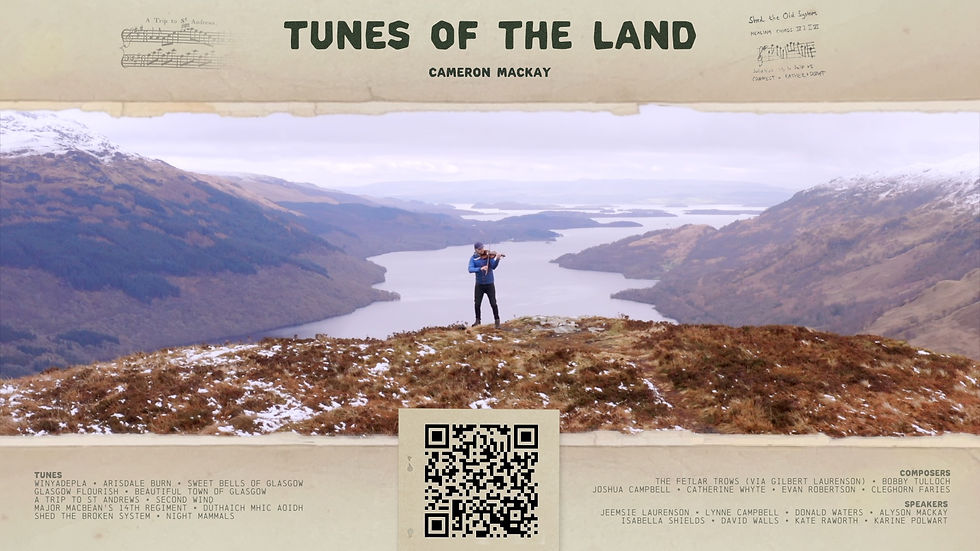
Thank you so much for coming to the gig! Below, you will find a full list of the traditional and original tunes performed. For each tune, you will find: sheet music; resources that tell the stories of the tunes and links to good recordings of them.
Explore more of Cameron's music here. This show is in the early stages of development and it is hoped to roll it out further to use as a tool to engage environmental organisations in conversations about how we can use our Living Heritage (e.g. fiddle tunes) as a means of taking action on climate change. Please get in touch to share feedback or explore collaboration and new audiences for this work.
The audio recordings played as part of this gig feature poetry by Palestinian poet Mosab Abu Toha. Please considering giving a small donation to him to support his work here.
SET 1 | FAIRY TUNES FROM FETLAR
Two tunes that come directly from the land in Shetland, setting the stage for how we consider using folk music as a way of communicating with the more-than-human world.
The audio used in this set was made possible through kind permission from Tobar an Dualchais and the School of Scottish Studies.
"Winyadepla" by the Fetlar Trows [sheet music]
Story of the Tune [and audio used]: Jeemsie Laurenson via Tobar an Dualchais
Good Recording: Aly Bain & Tom Anderson
"Arisdale Burn" by Bobby Tulloch [sheet music]
Story of the Tune: Bobby Tulloch's exhibit at the Old Ha museum in Yell, Shetland
Good Recording: George Spence
SET 2 | JOSHUA CAMPBELL'S 1700 GLASGOW TUNES
A set of tunes from 1700s Glasgow-based fiddler and bell-ringer, Joshua Campbell. Discovered through Historic Music Scotland, through the work of David McGuinness, Aaron McGregor and Karen McAulay.
Featuring a reading of the Glasgow Crest poem by Lynne Campbell, Donald Waters, Isabella Shields, and David Walls.
SET 3 | TWO ST ANDREWS TUNES, WRITTEN 200 YEARS APART
A set of tunes from the West Sands beach in St Andrews, one written by Catherine Whyte in the 1700s and one written by Cameron Mackay in the 2020s.
Catherine Whyte's music was discovered through Aaron McGregor's article "Female Composers in Scotland's Golden Age".
"A Trip to St Andrews" by Catherine Whyte [sheet music]
"Second Wind" by Cameron Mackay [sheet music]
Story of the Tune: How Second Wind was written and how Sophy Louise created the artwork
Recording: Cameron Mackay
"Major Macbean's 14th Regiment" by Catherine Whyte [sheet music]
Story of the Tune: Major McBean's heroic efforts at Culloden
SET 4 | 1800s PROTEST SONG: "DÙTHAICH MHICHAOIDH"
An 1800s protest song and connected slow air tune called Dùthaich MhichAoidh ("Mackay Country" in Gaelic, which refers to the area of northwest Sutherland in Highland) about the Highland Clearances, written by Evan Robertson.
This features a reading of Mosab Abu Toha's poem "We Love What We Have" by Alyson Mackay. Donate to Mosab to support his work here.
SET 5 | FIDDLE TUNES AS CLIMATE ACTION
Two original jigs that connect to taking action on climate change.
"Shed the Broken System" is a jig that was written live as part of a workshop (run by Lynne Campbell with Culture for Climate Scotland) to document the ideas that came from participants. Read the full report on how live composing of fiddle tunes can act as a workshop documentation tool.
Night Mammals is a contemporary fairy tune that came from the Cleghorn Farm fairies via Cameron Mackay. On returning from a walk in the forest and playing it to bandmate Lynne Campbell, she shouted "that's a fairy tune!". Underpinning climate action is a need to form connections with the land and recieving fairy tunes is only possible through forming deep connections with forests, moorland and coastlines.
The audio used here is a clip of an interview recorded with Karine Polwart about how traditional music can address climate change. Thank you to Karine for her permission to share her words.


Comments